
Does your brand actually need a tagline?
Most companies commission one before anyone has said what job it is meant to do.
If you are asking whether your brand needs a tagline, the honest answer is probably not. A tagline earns its place when it does a job nothing else in your brand can do: name the category when your name does not, state a position the market cannot otherwise see, or hold a promise the business is actually paying for. If none of those jobs is open at your company, the line you commission will sit under the logo and do nothing at all. Most of them do exactly that.
There are numbers on this. “Be Distinctive. Everywhere.”, the study Ipsos ran with the design firm Jones Knowles Ritchie in 2023, tested 5,046 brand assets from 523 brands across 25 countries with more than 26,000 people. Only 6% of slogans reached gold, JKR’s top tier, meaning the asset brings the right brand to mind on its own with the name taken off. Products managed 30% and logos 19%. Slogans did not merely finish near the bottom, they collapsed into it: 81% landed in bronze, the weakest tier, which JKR calls “almost entirely forgettable”. That is not because the writing got worse. Most of those lines were written to fill a space rather than to carry a load.
What a tagline is actually for
A tagline is a load-bearing sentence or it is nothing. The clearest case for having one is a product unfamiliar enough that the name leaves people guessing, where the line has to do the explaining before anyone will put the thing in a basket.
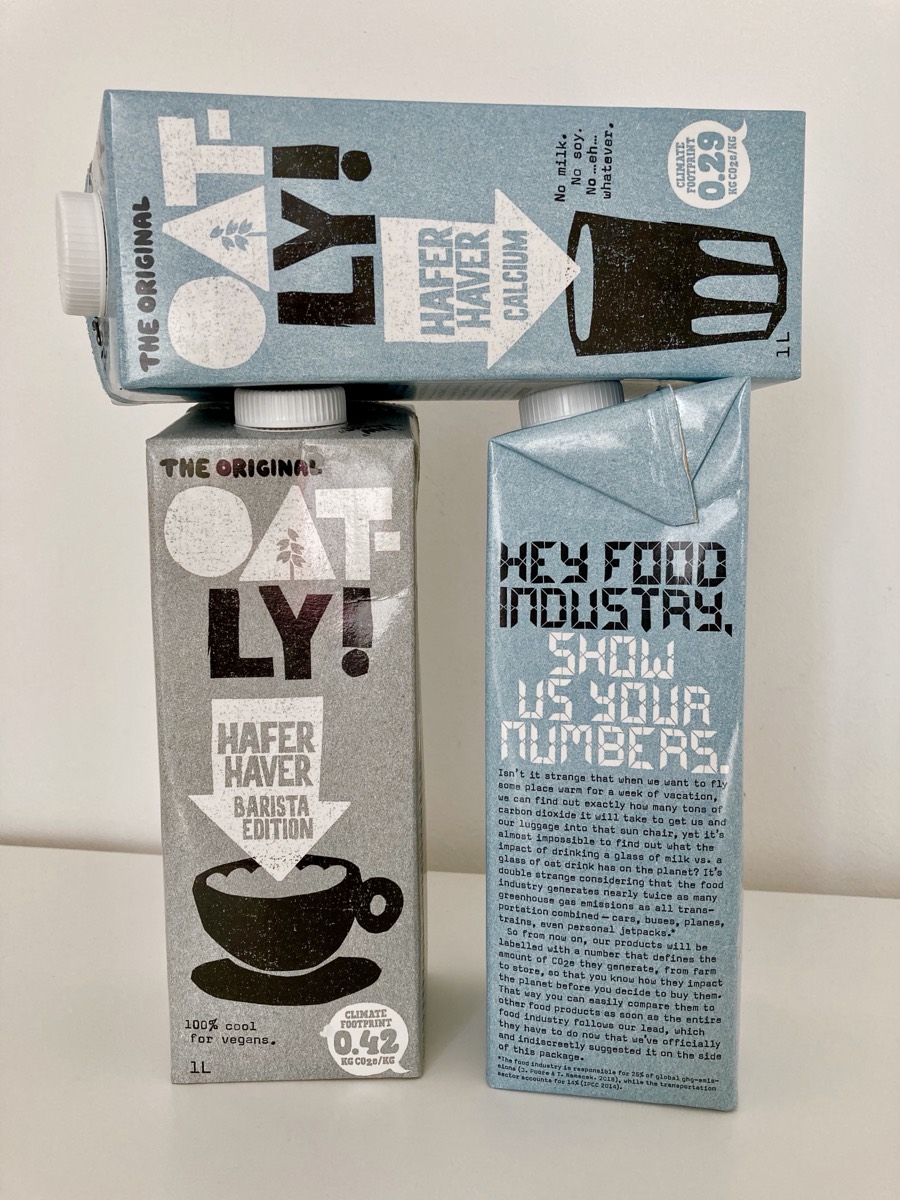
Oatly is the sharpest example of the past decade. “It’s like milk but made for humans” is not a mood. In nine words it tells you what the product is, what it replaces, and what the company thinks about the thing it replaces, on a shelf where most shoppers had never heard of oat drink. It also cost them. In 2015 the Swedish dairy lobby LRF Mjölk took Oatly to court over its milk messaging, and Oatly lost, ordered to stop calling its own product milk and to stop implying cow milk was unfit for people. Six years later the argument ran the other way. On 20 January 2021, in Oatly v EUIPO (case T-253/20), the EU General Court held that the same sentence was distinctive enough to register as a trade mark, reasoning that the word “but” set off a thought in the reader that made the line stick.
Read that sequence again, because it is the whole point. Oatly’s line was worth going to court over twice, in opposite directions. It carried an argument. Most lines carry a mood, and nobody has ever litigated a mood.
Plenty of brands grow without one
A brand can succeed with no tagline at all, and some of the most trusted ones do. What stands in its place is usually the product explaining itself, plus something the company publishes often enough that people learn its voice without needing it compressed into a slogan.
Zerodha is the case worth studying, partly because it is so easy to check. India’s largest retail broker has never advertised. Founder Nithin Kamath told afaqs in January 2025 that 16 million Indians have traded and invested on the platform and that almost 30% of them arrived through referrals from existing customers, adding that advertising would have handed a large share of the firm’s profit to Google and Meta. What Zerodha built instead was Varsity, a free education library, and years of plain writing about markets under its own name. There is no line beneath the logo because there is no gap for one to fill.
Who Gives A Crap gets to the same place from the opposite direction. The name handles the category, the joke and the attitude in three words, so there is nothing left for a tagline to add. In its place sits a commitment with a number attached: half the company’s profits go to sanitation projects, published on its own site with the running total. That promise does more brand work than any sentence a studio could have written to sit above it.
A mission is not a tagline, and neither is a positioning line
When a company asks for a tagline, what it usually wants is agreement. Someone senior has noticed that four people describe the business four different ways, and a short sentence looks like the cheapest fix. It is the wrong instrument. As the marketing writer Karine Regev put it in December 2025, “teams want a story the entire organisation can work from, not another tagline.” That is her opinion rather than a finding, and it matches what turns up in briefs.
Three different things get called by the same word, which is where the muddle starts. A positioning line is internal: it settles what you are for and who you are not for, and it never has to sound good. A mission is a commitment the business pays for, which is why the Who Gives A Crap promise reads as substance rather than copy. A tagline is public, meant to last, and sits with the mnemonic. You need the first. You may need the second. The third is optional, and it cannot be written honestly until the first one exists.
The test is to take it away
Here is the cheapest way to answer this for your own brand. Pull the line off the homepage, the deck, the email footer and the packaging for one quarter, then ask what broke. If sales conversations got harder, if people stopped understanding what you sell, if your own team lost its footing describing the company, the line was carrying weight and your job now is to protect it for the next ten years. If nothing happened, you have your answer, and you have saved yourself a workshop.
Almost nobody runs that test, because the likely result is awkward for everyone who approved the line. The alternative is worse: paying every few years for a fresh arrangement of the same words, because changing the sentence feels like progress while the argument nobody settled stays unsettled.
So write the line last, if you write one at all. Work out what you are for, name who you are not for, and put a real cost against the promise you are making. If a sentence then turns up that does something nothing else in the brand can do, write it down and defend it for a decade. If one does not, leave the space under the mnemonic empty. Empty says less than a sentence that means nothing, and it is far cheaper to keep.
Frequently asked questions
Does my brand need a tagline?
Probably not. A tagline is worth having when it does a job nothing else in your brand can do, usually explaining an unfamiliar category, stating a position the market cannot see on its own, or carrying a promise the company genuinely pays for. If your name and your product already do that work, a line adds nothing but a maintenance cost. Write it last, if at all.
Can a brand be successful without a tagline?
Yes, and some of the most trusted ones are. Zerodha became India’s largest retail broker with no advertising and no line under the logo, growing through referrals and its own free education library instead. When the product explains itself and the company publishes often enough for people to learn its voice, there is no gap for a tagline to fill.
What is the difference between a tagline and a mission statement?
A mission is a commitment the business pays for, and it is judged on whether the company actually honours it. A tagline is public-facing, sits with the mnemonic, and is judged on whether anyone remembers who said it. Companies get into trouble when they ask for a tagline while what they really need is the mission settled first, because a line written before that argument is resolved has nothing underneath it.
Campaign imagery remains the property of the respective brands and agencies, shown here as editorial reference with credit.